
Most shipping damage follows predictable patterns, and once you can identify which issues affect your products, you can select the right protective solution to prevent them. Given the high costs and customer dissatisfaction associated with damaged deliveries, identifying these patterns is critical.
Learn more about common shipping damage patterns and solutions for keeping your packages secure in this guide.
1. Impact and Compression Damage
Impact and compression are among the most common shipping damage patterns for online retailers, affecting both palletized goods and individual boxes.
Impact damage results from sudden shocks, such as drops from conveyors, falls during loading and unloading or rough handling by carriers. The evidence is usually clear. Look for cracked or shattered products, dented corners on items themselves and broken internal components that suggest a forceful collision occurred during transit.
Compression damage occurs when the weight of stacked packages exceeds the packaging’s capacity. You’ll notice crushed box corners, deformed packaging that no longer holds its shape and items inside that have been bent or flattened from sustained pressure. Common causes include using cartons with inadequate stacking strength, high humidity that weakens materials or improper pallet stacking patterns that concentrate weight unevenly.
Impact and compression issues require materials that add structural integrity and stacking strength, such as:
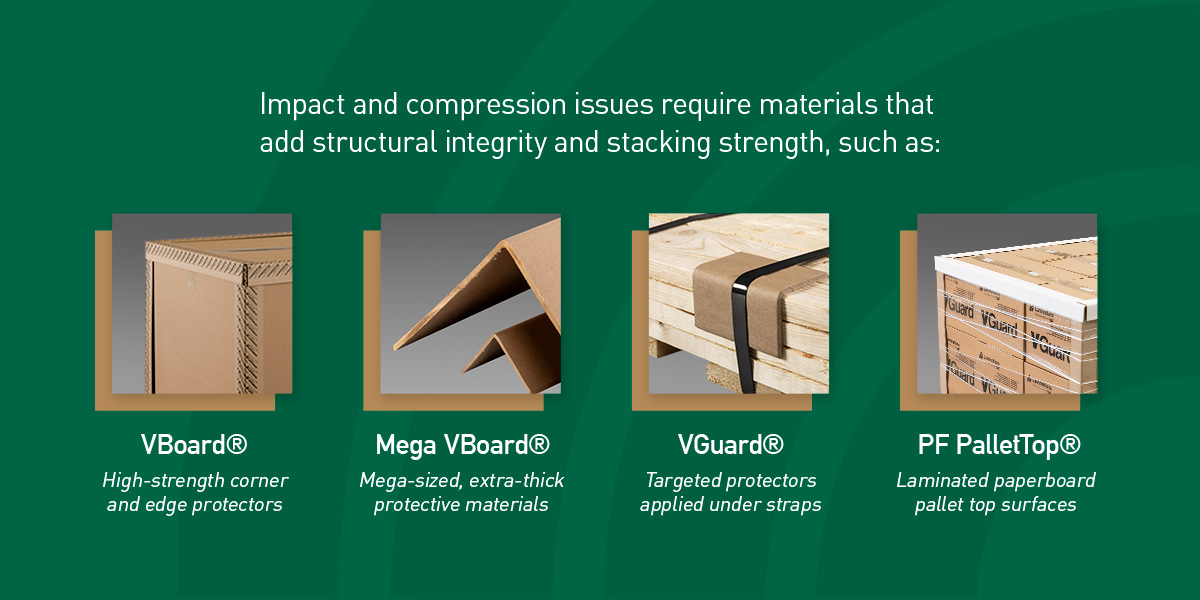
High-strength corner and edge protectors improve stacking strength and protect corners from crush damage on standard pallet loads.
Mega-sized, extra-thick protective materials provide maximum crush resistance for heavy-duty applications with extreme weight.
Targeted protectors applied under straps distribute tension and prevent compression damage at pressure points.
Laminated paperboard pallet top surfaces secure the entire pallet surface and distribute weight evenly to prevent top-layer crushing.
2. Abrasion Damage
Abrasion damage affects the surface of products when they rub against packaging or other items inside. Vibration and friction during transit cause this movement, even in well-packed boxes. Common sources include:
- Bumpy roads and running engines.
- Track switches and coupling.
- Takeoff, turbulence and landing.
Keep an eye out for scuffed finishes, scratched labels and worn edges. For both direct-to-business (DTB) and direct-to-consumer (DTC) brands, even small scratches can make products unsellable. To avoid abrasion damage, consider:
Packaging with built-in lining creates an abrasion-resistant barrier between products and packaging surfaces to prevent scuffs.
Fully enclosed protective paperboard crates provide complete isolation from all external contact risks during handling and transit.
3. Moisture Damage
Moisture damage occurs when packaging or products are exposed to water or high humidity. Signs include weakened or soggy materials, warped product components and, in severe cases, mold or mildew.
For food and produce companies, wet packaging can lead to microbial growth that violates safety regulations. Check your shipping lanes for high-humidity climates or rain-prone routes to choose moisture protection that matches those conditions.
Standard paperboard loses strength when exposed to water or high humidity. Moisture-prone shipping environments require specialized materials with varying levels of water resistance, like:
Protectors with specialized poly-coated surfaces maintain structural integrity in moderate humidity. They also resist grease and oils when products encounter incidental contact.
Superior water-resistant protective coatings cause water to bead and roll off, keeping materials and products dry. This advanced protection prevents weakening even during extended transit.
4. Puncture Damage
Puncture damage occurs when an object pierces the packaging from the outside or when a sharp edge on the product breaks through from the inside. You’ll see holes, tears or breaches in the packaging material.
For pharmaceuticals and cosmetics, a punctured package can violate the Food and Drug Administration (FDA) tamper-evident guidelines, making the product unsellable. This type of damage requires solutions that shield against external punctures or cushion sharp product edges.
Puncture prevention works through three protective materials:
Dense flat paperboard panel liners reinforce entire surfaces against external punctures from forklifts, pallet jacks and other warehouse equipment.
Heavy-duty inflatable protective air bags fill gaps and create a buffer that prevents sharp product edges from contacting packaging walls.
Custom paperboard corner protectors that fold into 90-degree angles cover and blunt sharp corners, eliminating puncture risk from inside the box.
5. Edge Damage
Edge damage specifically affects rolls, coils and cylindrical products when the circular edges are crushed, dented or deformed during handling and transport. Unlike the flat corner damage that occurs with standard boxes, edge damage compromises the structural integrity of rolled products, such as paper rolls, fabric rolls, steel coils, wire spools and similar items.
These shapes require materials that conform to curves, such as:
Flexible protectors that conform to curves provide edge-damage protection for coiled or cylindrical items with non-standard shapes.
Coiled edge protection for roll products protects the outer diameter of rolls and offers easy application that stays in place during handling.
Complete Your Shipping Damage Prevention Strategy
Analyzing packaging failure patterns affecting your products and selecting the right protective materials are only part of the solution. Proper packing techniques and validated testing ensure your packaging performs as expected in real-world conditions.
Implement Proper Packing and Stacking Techniques
Since each product return costs companies between $25 and $30, preventing damage through proper packing directly protects your bottom line. Following these techniques maximizes the effectiveness of your protective packaging:
Minimizing movement inside boxes reduces risks of impact and abrasion damage during transit. Custom-sized packaging creates the precise fit needed.
This palletizing technique provides maximum strength by aligning boxes directly on top of each other rather than offset patterns.
Wrapping palletized loads holds boxes in place and prevents shifting during transport.
Boxes that extend beyond the pallet edge create weak points that can be damaged by forklifts and handling equipment.
Validate Your Solution With ISTA Testing
The International Safe Transit Association sets industry-standard testing procedures that simulate real shipping conditions. ISTA testing validates whether a packaging solution protects products under the specific stresses they’ll encounter in your supply chain.
Testing removes guesswork by subjecting packages to compression, controlled drops, vibrations and environmental conditions that mirror actual transit conditions. For operations managers, e-commerce brands and retailers implementing new protective solutions, certified testing provides confidence that the investment will perform as expected.
Partner With Great Northern Laminations® to Engineer a Solution
Laminations has over 50 years of experience developing custom protective packaging solutions that address the unique challenges your products face. With a certified ISTA testing lab and an expert team of packaging engineers, we can help you diagnose damage patterns, design the right protection strategy and validate solutions before they reach your supply chain.
Fill out our online form today to get started.